The Real Cost of Precious Opal: Inside the Gray Market and the Human Tragedy of the Welo Mines
When consumers admire the vibrant, shifting colors of a premium hydrophane opal, they rarely consider the exact supply chain that brought the gem to their jewelry box. While legacy gemological institutions remain focused on maintaining outdated market statistics and protecting historical valuation metrics, an urgent human and environmental crisis is unfolding within the underground gemstone trade.
The global opal industry relies heavily on an informal, undocumented pipeline—frequently referred to as the gemstone gray market. By stripping away the corporate marketing jargon, we expose the deep human toll, environmental devastation, and systemic exploitation built into untraceable gemstone sourcing.
What is the Gemstone Gray Market? The gray market operates as a parallel supply chain where raw materials are legally mined but illegally or informally exported outside of official government channels. In the context of the modern opal trade, massive quantities of rough Ethiopian opal are smuggled out of Africa directly to massive cutting hubs like Jaipur, India.
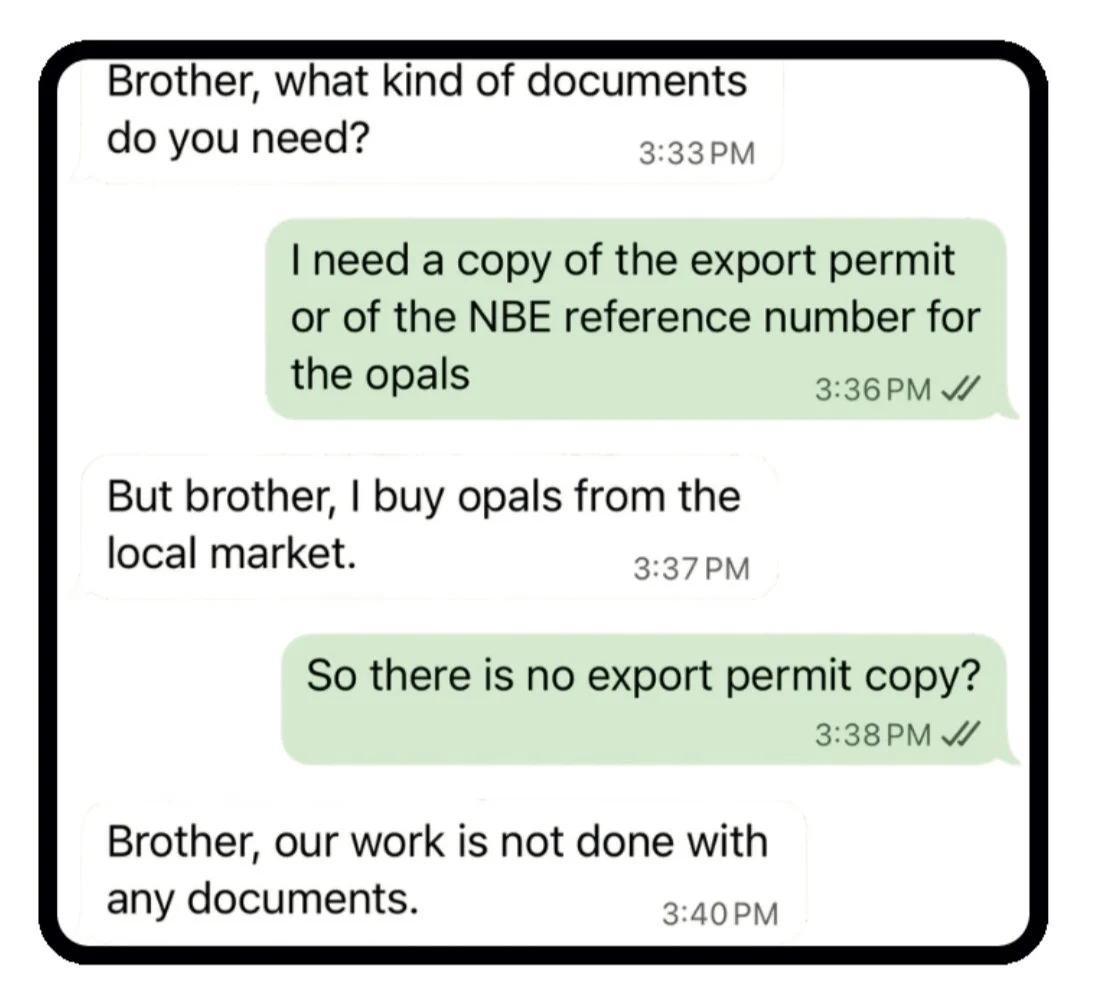
This “Jaipur Loophole” intentionally bypasses sovereign regulations—such as the strict tracking mandates enacted by the Ethiopian Ministry of Mines (MoM) and the National Bank of Ethiopia (NBE). Because these transactions occur entirely off the books, the true volume of international opal production is obscured, allowing middlemen to maximize their profit margins at the absolute expense of the native workforce.
Systemic Exploitation: Squeezing the Artisanal Miner
The economic mechanics of the gray market directly suppress the livelihoods of independent, local miners.
Predatory Pricing: Middlemen buy high-quality rough material for pennies from indigenous artisanal miners who lack direct access to global markets.
Wealth Extraction: The true value of the gem is only realized after it is processed and polished abroad. As a result, the wealth generated by Africa’s natural resources is completely extracted from the local community and funneled into international corporate networks.
No Financial Safety Net: Because these supply chains are undocumented, miners do not receive fair-trade premiums, baseline wages, or any form of institutional financial security.
Environmental Degradation and Deleterious Mining Practices: When a supply chain operates completely in the shadows, environmental accountability disappears entirely. The gray market directly incentivizes destructive, unregulated extraction methods.
Unregulated Structural Excavation: To keep up with the explosive global demand for hydrophane material, informal operations prioritize speed over structural safety. Mines are dug without proper engineering blueprints, structural pillars, or standard shoring techniques, leaving subterranean tunnels highly susceptible to collapse.
Severe Land Deformity: Without regulatory enforcement or oversight, mining sites are completely abandoned once the high-grade pockets are depleted. This leaves the landscape scarred with open pits, accelerating severe soil erosion and destroying local agricultural potential.
The Ultimate Human Cost: The Deliberate Delay of Justice: The absolute depth of this institutional neglect was demonstrated by a devastating recent tragedy in the Welo mining region, where a massive, un-shored mine shaft suffered a catastrophic structural cave-in. Thirty artisanal miners were buried alive. In a regulated industry, an immediate, heavily-funded rescue and recovery operation is mandated by law. In the unregulated black box of the opal gray market, these men were treated as entirely disposable. Because the operation was undocumented, there was no corporate liability, no insurance infrastructure, and no official accountability to trigger an immediate response. The bodies of those thirty miners were left abandoned beneath the rubble for nearly a full year before any recovery efforts were executed. For twelve months, local families were forced to live alongside a mass grave, waiting for the industry to acknowledge the physical human cost of its asset supply chain. This deliberate delay of basic human dignity serves as definitive proof that consumer ignorance is actively weaponized to protect commercial margins.
Dismantling the Loophole Through Sourcing Transparency: The modern jewelry industry frequently prints marketing materials claiming their gemstones are “ethically and responsibly sourced.” However, if a supplier cannot produce verifiable Ministry of Mines (MoM) origin paperwork and a National Bank of Ethiopia (NBE) reference number, those ethical claims are completely fraudulent.
Independent material analysis labs and transparency advocates are actively working to disrupt this system. By demanding rigid supply-chain documentation and executing targeted audits on global suppliers, independent gemologists are forcing the industry to face its systemic non-compliance.
How Consumers and Jewelers Can Fight the Gray Market:
Demand the NBE Reference Number: Never purchase bulk commercial parcels based purely on verbal assurances of “ethical origin.” Demand a verifiable legal paper trail.
Support Independent, Direct-Source Lapidaries: By cutting out the predatory middleman networks, capital goes directly back into the hands of the indigenous mining communities.
Reject the “Don’t Ask, Don’t Tell” Policy: Every jeweler has a legal and moral obligation to audit their supply chains. True luxury cannot be built on top of un-recovered mass graves and environmental destruction.
The shifting play-of-color inside a precious opal should represent natural geologic wonder—not the unrecorded exploitation of the people who pulled it from the earth. It is time for the global gemstone market to retire its outdated historical narratives and establish a standardized, transparent, and humane framework for the modern era.
